Why is My AC Running But Not Cooling My Home in South Louisiana?
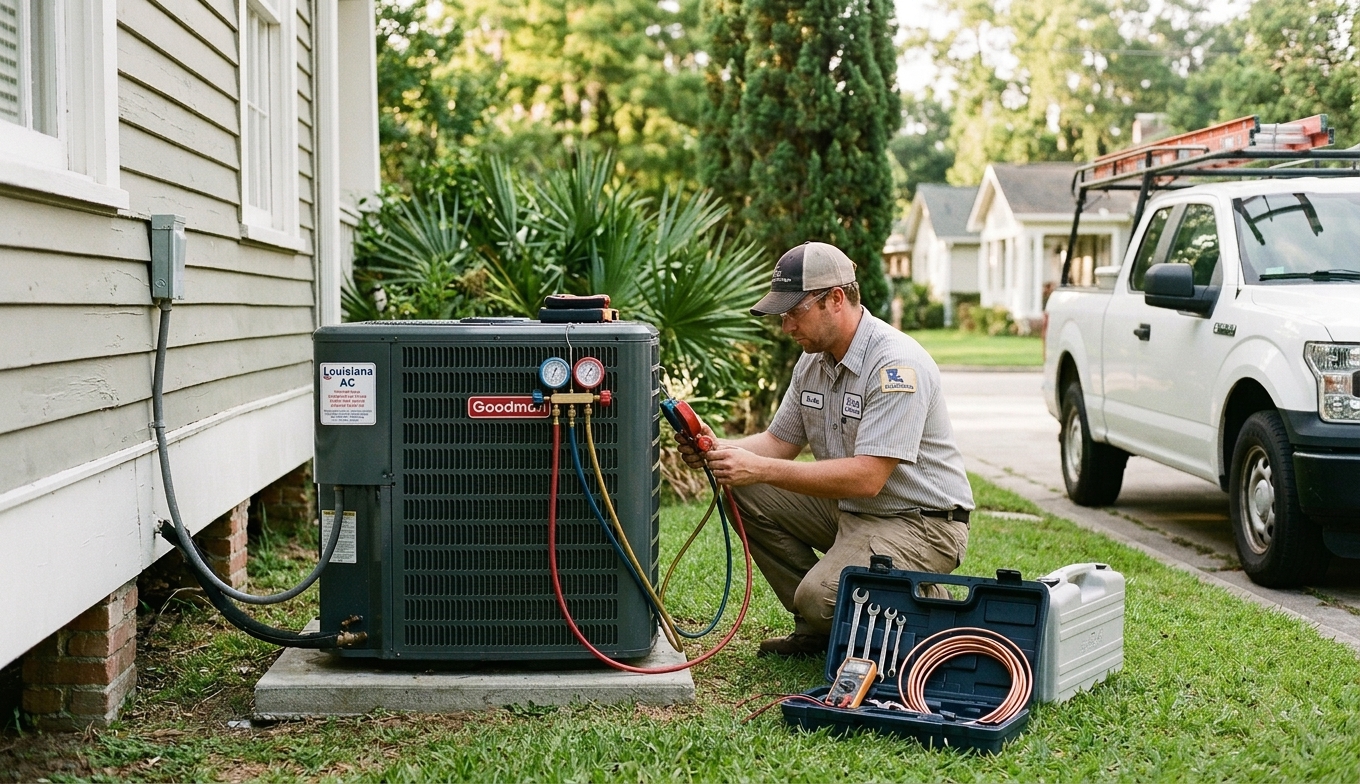
When your air conditioner is running but your house feels like a swamp, the answer to "why" comes down to a broken heat transfer process. At its core, an air conditiner doesn't actually create cold air; it absorbs heat and moisture from inside your home and dumps it outside.
If your AC isn't cooling, it is because restricted airflow (like a dirty filter), a refrigerant leak, or a failing electrical component (like a blown capacitor) is preventing that heat transfer from happening.
In South Louisiana, where the summer heat is relentless and the humidity is thick, a minor disruption in this process leads to a hot house in a matter of hours. GeauxHVAC will break down the main reasons your air conditioner is blowing warm air and how to fix it.
1. Suffocated Airflow - The Choked Filter
Your air conditioner needs to breathe. The indoor evaporator coil absorbs heat from the air blowing across it. If your air filter is clogged with dust, pet dander, or debris, warm air can't reach the coil.
When this happens, the refrigerant inside the coil drops below freezing. The natural humidity in your home then freezes directly onto the coil, turning it into a block of solid ice. An iced-over AC will run constantly but blow warm, weak air.
- The Fix: Change your air filter every 30 days during a South Louisiana summer. If the coil is already frozen, turn the thermostat from "Cool" to "Off" and switch the fan to "On" to let it thaw before calling for repair.
2. The Refrigerant Leak - Starving the System
Air conditioners do not consume refrigerant (often referred to as Freon). It is a closed-loop system. If your AC system is low on refrigerant, it means you have a leak.
Refrigerant is the lifeblood of the cooling process. When levels drop, the system can't absorb enough heat from your indoor air. You might notice the air coming from your vents feels lukewarm, or you might hear a faint hissing sound near the outdoor unit.
- The Fix: Adding more refrigerant is only a temporary band-aid. A professional HVAC technician must locate the leak, seal it, and recharge the system to the manufacturer's exact specifications.
3. A Dead Capacitor - The Electrical Heart Attack
If your indoor fan is blowing but the air is warm, walk outside and listen to your condenser unit. Is it humming, but the fan at the top isn't spinning? Or is the fan spinning, but the unit is weirdly quiet? You likely have a dead run capacitor.
The capacitor is a small, cylindrical battery that delivers a massive jolt of electricity to start your compressor and outdoor fan. Our Baton Rouge heat forces these components to work overtime, and capacitors are often the first things to fry. If the compressor isn't running, no cooling is taking place.
What Other HVAC Companies Aren't Telling You
Generic AC troubleshooting guides cover the basics, but living in South Louisiana introduces unique challenges that dictate how your air conditioner performs. If the basics check out, your lack of cooling is likely due to one of these localized factors.
The Louisiana Soil Shift - Condenser Tilt
Nobody talks about the ground your AC sits on, but in Southern Louisiana, our alluvial soil shifts, expands, and sinks—especially after torrential summer downpours. Over time, the concrete or plastic pad supporting your outdoor condenser unit can sink on one side, causing the unit to tilt.
Why this ruins your cooling: The compressor inside your outdoor unit contains oil for lubrication, much like your car's engine.
If the unit tilts more than 10 degrees, the oil pools on one side and fails to lubricate the moving parts. The compressor overheats, trips its internal overload switch, and stops cooling your home. An unlevel unit also restricts the fan's ability to exhaust heat properly.
The Latent Heat Battle
In HVAC terms, there are two types of heat: Sensible heat (the temperature you read on a thermometer) and Latent heat (the moisture/humidity in the air).
In our climate, your air conditioner spends up to 70% of its energy just fighting the latent heat. It has to physically wring the water out of your indoor air before it can even begin to lower the sensible temperature.
If your AC is slightly undersized, or if your ductwork is pulling in humid attic air through small leaks, the system is spending all its power dehumidifying rather than cooling. The air coming out of the vents will feel "coolish," but the house will never reach your target temperature.
The Algae Chokehold (Zooglea)
Because your cooling system is pulling gallons of water out of the humid air every day, that water has to drain outside via a white PVC pipe (the condensate drain line).
In our climate, a specific type of biological slime called Zooglea thrives in these wet, dark pipes. When the algae clumps together, it clogs the drain.
Modern AC systems have a safety float switch that detects this backup and will completely shut off your outdoor unit to prevent your ceiling from flooding. Your thermostat will stay on, but the air will blow warm.
The GeauxHVAC Value Proposition
When your house is 85 degrees inside, you don't need guesswork. You need definitive answers and lasting solutions.
At GeauxHVAC, we don't just show up and blindly top off your refrigerant.
- We map out the entire health of your system.
- We check your condenser levels to combat soil shift, calibrate your system to handle Louisiana's massive latent heat loads.
- Then we clear your drain lines so you aren't left sweating on a Sunday afternoon.
If your HVAC is running but refusing to cool, don't let it run itself to an early grave.
Contact GeauxHVAC today by calling (225) 456-3360 if you need help near Gonzales, LA and let us restore comfort to your home with precision, honesty, and local expertise.